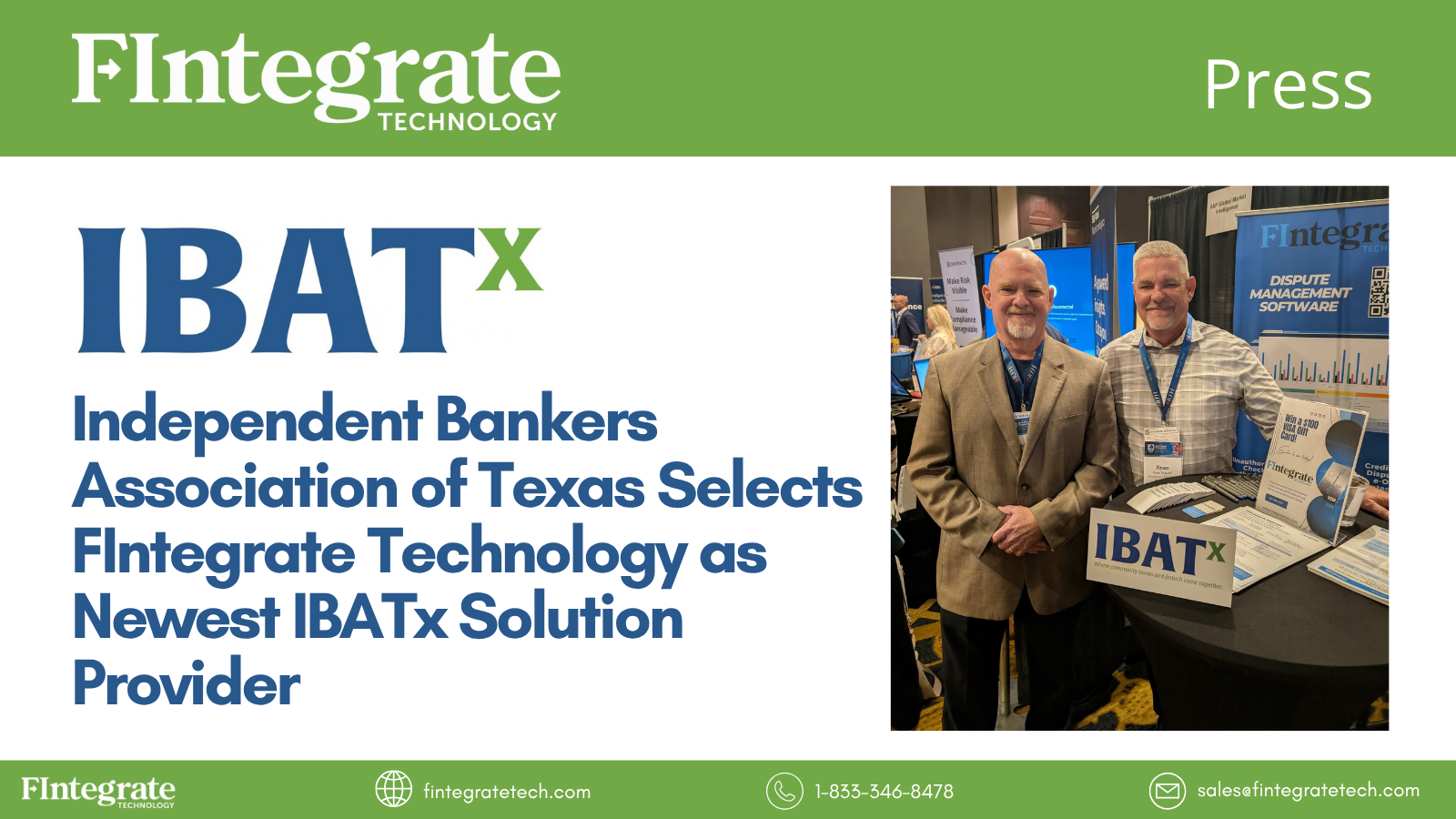
Independent Bankers Association of Texas Selects FIntegrate Technology as Newest IBATx Solution Provider
Partnership Brings Industry-Leading Dispute Management, Automation and Data Conversion Solutions to Texas Community Banks
Without the right management system, disputes pile up across email chains, spreadsheets and sticky notes. Reg E deadlines get missed and cases fall through the cracks.
FusionDMS is a better way to manage disputes, consolidating and automating workflows, compliance and audit trails in one powerful platform.
Reduction in dispute processing time
Boost in productivity
Chargebacks eliminated
Network fees avoided, per chargeback
Reg E deadlines are built directly into FusionDMS, with automated alerts, timers and escalations that keep every case on track.
Keep every case moving with automated workflows that guide your team through every step of the dispute process, eliminating manual re-entry and duplicate cases.
Every attachment, comment, action and status change is logged automatically, giving auditors instant access to complete case histories.
FusionDMS automates the full chargeback, representment and arbitration workflow, with an internal ledger that tracks provisional and final credits.
Real-time dashboards give managers instant and customizable visibility into case status, team workloads and dispute trends.
No two institutions are alike. That’s why our specialists will collaborate with your team to configure FusionDMS for your specific workflows and operational needs. And we’ll support you as those needs evolve.
When a cardholder reports a transaction dispute, FusionDMS automatically checks whether the case is intercept-eligible. If it is, FusionDMS alerts the merchant and requests a decision on a cardholder refund.
If the merchant issues a credit, the chargeback is intercepted before it is ever filed. No network fee. No investigation queue. The Reg E case closes with a documented merchant credit, and your team moves on.
For disputes below your institution’s auto-credit threshold, this is particularly valuable: instead of writing off a $25 or $50 claim, you get a documented merchant resolution that recaptures that value.
If the merchant declines, the attempt closes unsuccessful and the dispute works through the investigation workflow you already have.
Eligible disputes go straight to the merchant for a refund decision. Roughly 40% of those merchant alerts come back resolved in under 24 hours, so cases that used to sit in an investigation queue for weeks close the same day.
An intercepted chargeback is never filed, so the network fee is never incurred. On claims below your auto-credit threshold, you get a documented merchant credit instead of writing off $25 or $50 and calling it the cost of doing business.
Eligibility checks run automatically the moment a dispute is created, and routing happens behind the scenes. Your investigators work the same screen they work today: nothing new to learn, no second login, no copying case data between systems.
Chargeback Intercept runs in parallel with your existing Reg E workflow. The investigation clock starts when the cardholder reports, as required. Interception doesn’t bypass your compliance obligations; it accelerates resolution inside them.
When First Texas Data’s decade-old dispute management system was on the way to sunset, they replaced it with FusionDMS. That choice cut dispute processing times by 50%.
See how automated workflows and built-in Reg E compliance transformed their operation.
Most Reg E findings don’t come from fraud. They come from missed deadlines, misclassified disputes and incomplete documentation.
Our Dispute Management Buyer’s Guide shows you exactly what examiners expect and how to evaluate a solution that’s built to survive the exam.
FusionDMS handles ACH, debit card, credit card, ATM, check and remittance transfer disputes, covering the full range of transaction types your institution manages under Reg E and Reg Z.
Deadlines are built directly into the workflow. FusionDMS automatically tracks and alerts your team to every Reg E deadline based on claim type, so nothing slips through the cracks.
FusionDMS integrates with all major core processors including Jack Henry, Fiserv, FIS, DCI, CSI and Finastra. Integration is handled by our implementation team as part of the standard onboarding process.
Your choice. You can host FusionDMS in-house on your own infrastructure, or FIntegrate hosts it for you in our AWS environment. The functionality is the same either way, and an institution that starts in-house can move to the hosted environment later without changing how its team works.
Implementation timelines vary based on institution size and configuration needs, but FusionDMS includes a structured 30-day UAT window with issue tracking and weekly review meetings to ensure a smooth go-live. Your FIntegrate project team will establish a specific timeline during the onboarding process.
FIntegrate’s 100% U.S.-based support team is available to assist with questions, training and system updates. Beyond reactive support, FIntegrate engages with clients on an ongoing basis to identify new opportunities and address evolving needs.
Chargeback Intercept resolves an open cardholder dispute before it becomes a formal chargeback. The dispute already exists. The cardholder has reported it to their bank or credit union. Chargeback Intercept notifies the participating merchant in real time, giving them a window to issue a refund through their acquirer before the chargeback is submitted to the network. If the merchant credits the cardholder, the chargeback is never filed, saving the institution the network fee, the investigation time, and the chargeback ratio impact. It is built directly into the FusionDMS dispute intake workflow. This is sometimes called dispute deflection in the payments industry.
Eligibility depends on whether the merchant participates in the card network’s merchant alert programs, and FusionDMS checks that automatically the moment a dispute is created. Your staff does not screen for it.
No. Chargeback Intercept runs through the card alert networks, so it applies to card disputes only. FusionDMS still handles ACH, check, ATM and remittance transfer disputes exactly as it does today, with case deadlines tracked automatically. Chargeback Intercept is an additional path for card claims, not a replacement for the rest of the workflow.
Chargeback Intercept works across the major card networks’ merchant alert programs, so coverage is not limited to a single card brand. Eligibility is checked automatically at dispute intake, and alerts are submitted with a single action from the existing dispute screen, no separate platform or additional login required.
Response windows vary by network, generally 24 to 72 hours before the chargeback becomes official. In practice about 40% of merchant alerts come back resolved in under 24 hours, so cases that used to sit in an investigation queue for weeks can close the same day.
The dispute continues through the investigation workflow you already have, and nothing is lost. The Reg E clock started when the cardholder reported the transaction and kept running throughout, so an unsuccessful intercept attempt leaves you on exactly the timeline you would have been on anyway. FusionDMS logs the attempt and the outcome as part of the case history.
Both. The networks’ merchant alert programs carry fraud and non-fraud reason codes, including service disputes such as a cancelled subscription or goods that never arrived. Eligibility is determined by merchant participation in the network, not by how the claim is classified. Your existing rules for handling fraud claims do not change.
No. Reg E timers begin the moment a cardholder reports a dispute, whether or not an intercept is attempted. FusionDMS tracks all required deadlines in parallel. If a merchant alert results in a merchant refund, the Reg E case closes with a documented resolution. If intercept is unsuccessful, the investigation continues on the same timeline it would have followed anyway.
A intercepted chargeback is never filed, so it is never counted. That removes the $25 to $35 network fee and keeps the case out of your chargeback volume. The cardholder is still made whole, through a documented merchant credit rather than a chargeback, and the Reg E case closes with that resolution on file.
Every chargeback that reaches the network carries a $25–$35 network fee, plus an average of 30–60 minutes of staff investigation time. For institutions that auto-credit disputes below a certain dollar threshold rather than investigate them, that cost is absorbed entirely. Chargeback Intercept eliminates the network fees and reduces investigation time for eligible disputes, while also recovering value on low-dollar claims that would otherwise be written off.

Partnership Brings Industry-Leading Dispute Management, Automation and Data Conversion Solutions to Texas Community Banks

FusionDMS helps credit unions and community banks automate dispute workflows, meet Reg E and NACHA deadlines, and produce audit-ready compliance reports without adding headcount.

When evaluating dispute management technology, one of the biggest decisions isn’t just which platform to choose, it’s how you want to deploy it. Should your institution host the solution internally, or should your technology provider manage the infrastructure for you?

Regulation E exam findings are not declining. Federal Reserve, FDIC, and NCUA examiners identified electronic fund transfer violations among the most frequently cited consumer compliance failures in 2024 — and the pattern is consistent across institutions of all sizes.

A community bank we’ve worked with for years recently went through a core conversion. They needed the answer to this question, “What are we going to do with the old checks, statements & reports?”

Huge thanks to The Credit Union Connection for featuring this article that highlights the story on the new partnership between FIntegrate Technology and OMNICOMMANDER.
Whether you’re ready for a demo or just exploring your options, we’d love to hear from you. A member of our team will be in touch shortly.